
Want campaign experience before you run yourself? Here is how to volunteer for a political campaign: choose a role that fits your time, contact the candidate’s campaign through its website, and start with a small task.
Roles run from sharing a link to organizing other volunteers, and they are ranked below by time and skill. For the wider picture of civic participation, see our guide on how to get involved in local politics.
Campaign volunteer roles at a glance
Campaign volunteer roles range from forwarding an email to running field shifts. The right first step depends on how much time you can give and how comfortable you are talking to strangers. Campaigns usually have a standing list of jobs to do, as SAGE notes about political organizations, so a willing beginner usually has something useful to do.
| Role | Time commitment | Skill needed | Planning use |
|---|---|---|---|
| Online sharing (email, links) | Lowest; fits spare moments | Minimal | A trial run to see whether you like the campaign’s message and people |
| Office tasks | Low; usually flexible | Minimal | Meet staff and see how the operation runs |
| Event and outreach table | Low to moderate; tied to event dates | Friendly, willing to start conversations | Practice speaking with the public in a relaxed setting |
| Phone banking | Moderate; set calling sessions | Comfort with a script and with rejection | Voter contact without leaving a chair |
| Canvassing | Moderate to higher; scheduled and outdoors | Conversation, listening, composure at the door | The closest preview of retail campaigning |
| Volunteer coordinator or regular field office help | Highest; recurring and reliable | Organizing and follow-through | A view of scheduling, recruiting and strategy |
Task types draw on the National Association of Social Workers’ volunteer guidance and Harvard Law School’s guide to campaign work; the time and skill ratings are editorial judgement for first-time volunteers.
Sharing the campaign online
Online sharing is the lowest-commitment way to help, and it suits anyone who cannot yet promise regular hours. Sending or forwarding an email, linking to a campaign website, or hosting a site for a candidate, when you are not paid for it, does not count as a contribution under Federal Election Commission guidance on volunteer activity.
The limit is learning. You will not practice talking to voters, so treat this as a way to test a campaign, not a long-term plan. If the campaign’s tone and organization appeal to you, move up to calls or events.
Phone banking for beginners
Phone banking means making calls from a list, and it is the gentlest form of voter contact for a first-timer. Making phone calls is one of the standard tasks the NASW lists for campaign volunteers. SAGE suggests starting small with calls, emails or letters, and it advises that a lack of knowledge about politics should not deter you.
Ask the volunteer coordinator for the campaign’s script and for how to record each call’s outcome before you dial. Sit next to an experienced caller for a session if the office allows it. Calling suits people who prefer a fixed seat and a clear task, and it works well for those who dislike doorsteps. The trade-off is that you never see a voter’s reaction, so you learn less about reading a room than a canvasser does.

Canvassing tips
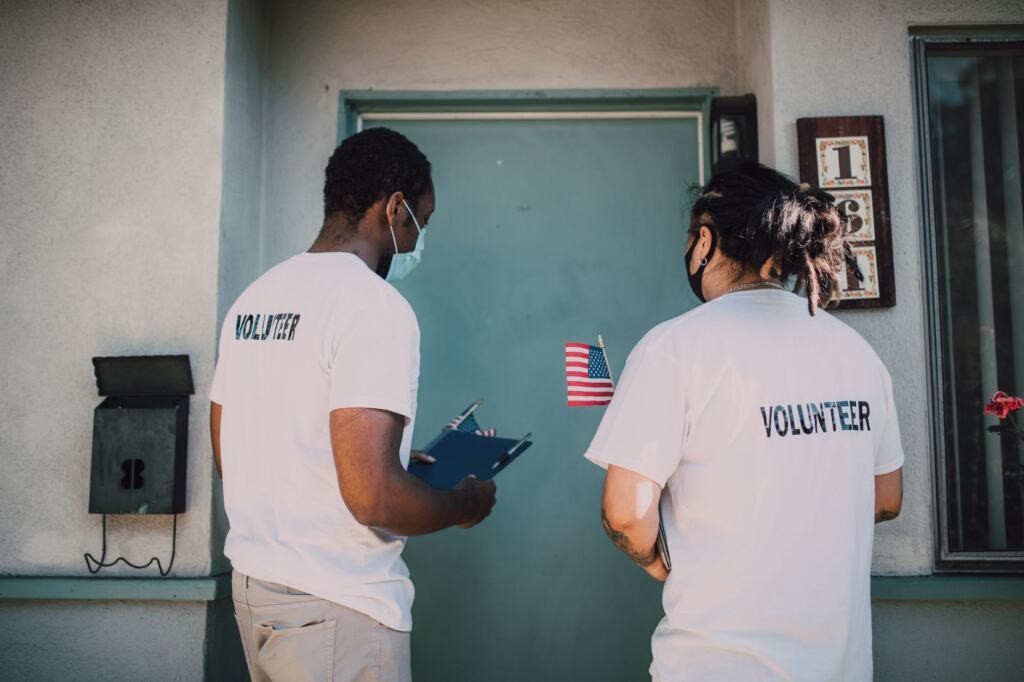
Canvassing is field organizing in which you engage the public, usually at their homes, about the candidate’s goals and ideas, as Harvard Law School’s campaign guide describes it. If you plan to run for office someday, this is the volunteer job most worth doing, because it builds the habit of listening to voters.

- Go out with someone experienced first. Watching a few doors before you knock your own removes most of the guesswork.
- Stay with the campaign’s materials and message. Your coordinator decides what you say and hand out, so ask for a briefing before each shift.
- Listen more than you talk. Voter contact is partly information gathering, and a brief, polite exchange is a good result.
- Accept that many doors will not open. Record what you can and move on without pressing.
Canvassing suits people who like being outdoors and can keep to a schedule. It asks more of your time and your comfort with strangers than any other beginner role, so try a calling session first if you are unsure.
Office and event tasks
Office and event work is the entry point for people who want to help without cold-contacting voters. The NASW lists organizing campaign events and working in campaign offices alongside phone calls. Harvard’s guide frames the choice for volunteers as headquarters or the field.
Office shifts are the best place to meet the staff who make decisions about volunteers. Event tables, such as a booth where you hand out flyers or buttons, let you practice short conversations in a relaxed setting. The limitation is variety: the tasks can be repetitive, and event work depends on the campaign’s calendar rather than your own.

Coordinator and field office roles
Volunteer coordinators appear among the campaign roles that Harvard’s guide lists, and for an aspiring candidate the coordinator’s seat is the most instructive. You learn how shifts are scheduled, how new volunteers are recruited and how field work is organized. The campaign field office is where much of this planning happens, so ask staff there what they need most.
You rarely start in this role. Earn it by showing up reliably for a few shifts, then ask what else the campaign needs. Part-time help is a normal route: Harvard’s guide notes that there are ways to assist campaigns without working on them full-time. The cost is time and dependability, because other volunteers rely on you showing up.
Finding a campaign and contacting it
Start with the candidate’s own website, which is the official route to volunteering. The NASW advises visiting the website of your local candidates for Congress and Senate to find out how to volunteer. Look for a volunteer or get-involved page, submit the form, and follow up with a short message to the volunteer coordinator.
Volunteering for a local candidate
Local races are often the easier way in. Harvard’s guide says many people find it easier to land a position with a hometown or home-state candidate. That makes a city council, school board or county candidate a practical choice for a first campaign. Your state or county election office website can confirm who is on your ballot, and your local party organization can tell you which of its candidates need help. If your interest is an issue rather than a candidate, how to start a petition describes another way to organize your neighbors.
Time commitment and experience
You do not need to give days each week. SAGE notes that most political volunteers are not full-time activists. It suggests making calls, writing emails or letters, or attending a meeting or two if you can. You can ask for a set amount of time up front, such as an occasional evening, and a good coordinator will plan around it.
A fixed program shows the other end of the scale. Ballotpedia’s Fellows, who do research rather than campaign work, contribute approximately 5 to 10 hours per week during the eight-week program. Its community researchers have no required time commitment. Ballotpedia also states that no prior experience is required for its volunteers. That is a useful benchmark if you are weighing how much steady time you can realistically offer.
Legal basics for volunteers
Unpaid personal service is generally safe. Under FEC guidance, an individual may volunteer personal services to a campaign without making a contribution, provided no one compensates the volunteer. If anyone pays you for the work, the activity is no longer considered volunteer activity, so be clear with the campaign about whether you are a volunteer or staff.
Government employees should ask their agency’s ethics office before volunteering, because employment rules on political activity can differ from the campaign finance rules above.
A short checklist for your first shift
- Decide how much time you can give, and pick the matching role from the table.
- Choose a candidate, favouring a local race if you want an easier way in.
- Find the volunteer page on the candidate’s website and submit your details.
- Message the volunteer coordinator to confirm what your first task is and what to bring.
- After a few reliable shifts, ask for a different role, such as canvassing or event help.
Frequently asked questions
Can a foreign national volunteer for a campaign?
Yes, with a limit. FEC guidance says a foreign national volunteer must be careful not to participate in the decision-making process of the campaign.
Can I volunteer using my employer’s computer or phone?
Only incidentally. The FEC guidance sets a limit of no more than 1 hour per week or 4 hours per month for incidental use of employer facilities. Treat that as a ceiling rather than a target, and check your employer’s own policy first.
Can I spend my own money on food for a volunteer event?
In limited amounts. The FEC allows up to $1,000 per candidate, per election, for food, beverage and invitations for volunteer-hosted events without it counting as a contribution, as explained in its volunteer activity guidance.